INTRODUCTION AND THE IMPORTANCE OF RESEARCH
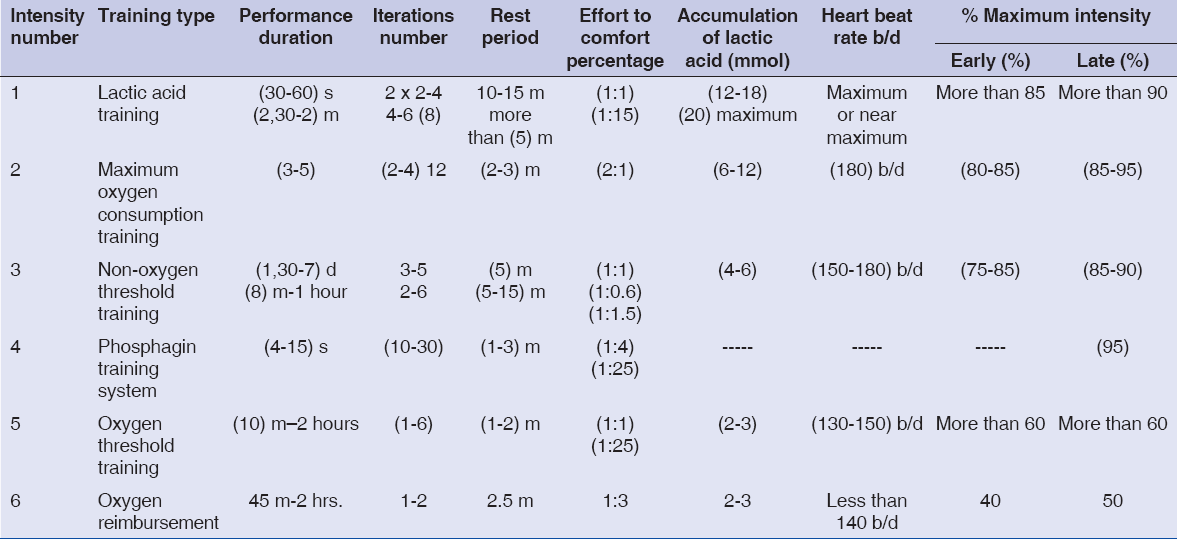
The conventional intensity zones are training intensity zones that include (lactic acid, the maximum limit of oxygen consumption, anoxygenic threshold, Phosphagenic system and oxygenic threshold). Bomba added a sixth zone which is oxygen compensation zone. The intensity zones are(Mohammed Reda Ibrahim 2008, 468-493).
First: Endurance Ability of Lactic Acid
The system that provides energy after the depletion of the Phosphagens and rebuilds the ATP inside the muscle is the anaoxygenic decomposition of the Glycogen. This system enables the athletes whose bodies can endure the pains of the increase of acidity in blood due to the hard training to perform physical efforts better and longer than the efforts of those who cannot endure the increase in blood acidity. Therefore, the purpose of the training of lactic acid system is to adapt the athletes’ bodies to the acidic impact of the lactic acid and to show larger resistance to the impact of lactic acid.
Second: Training of Maximum Oxygen consumption
The consumption of oxygen, for which the symbol vo2 is assigned, represents the volume of the oxygen absorbed by the body’s tissues from the inhaled air at standard temperature and pressure (stpd). We can get the maximum oxygen consumption (vo2max)by measuring the individual’s oxygen consumption while exercising the maximum physical effort he can do which sometimes called the maximum aerobic ability. The maximum consumption of oxygen is the best physiological indicator for the functional capability of the individual and a good evidence of the extent of his physical fitness. It represents indeed the utmost ability of the body to take and transfer the oxygen and then extract it in the acting cells(the muscles). The maximum oxygen consumption is equal to the output of multiplying the maximum output of the heart(the quantity of blood pumped by the heart per minutes) by the utmost arteriovenous oxygen difference(Mcgraw, 1987, p121).
Third: Anaerobic Threshold Training
It is the level of physical endurance that the transmission of lactic acid from the muscles to the blood increases much more than waste average rate. (Kighton & Hole:, 1997, 53)
This type of training Attributed to the physical effort (exercise), in which the level of prevalence rate of lactic acid reaches (4-6) m mol in the bloodstream, which exceeds the waste or remove rate.
Fourth: Phosphagene Energy System Training
Phosphocreatine (PC) is energy-rich phosphatic combination, it is found in muscle cells and when cut, it produces a large amount of energy, which helps to rebuild ATP. Mohammad Reda Ibrahim said, according to Mac Farlin, that improving the training level of phosphagene system is done by performing repeated physical efforts several times individually or in groups that contain certain occurrences. Effort duration shall not be more than (10) seconds for (10-20) times, in the case of groups, there shall be (4) groups repeat (3-4) times for each group - with break between each repetition and another (3-4) minutes (8-10) minutes between groups in order to have suitable break to get creatine phosphate back to muscle.
Fifth: Oxygenic Threshold Training
Oxygenic threshold is known as the threshold beyond which oxygen system improvement begins and equal to 60% of HR - max.
High oxygenic threshold training is a critical factor in improving the delivery of all sports events of medium and long duration as well as a major role in oxygen supply in order to provide the necessary energy as it becomes within the anaerobic energy systems and mixed system.
Sixth: Oxygen Indemnity: (Tudor Bompa, Carlo A. Buzzichelli:, U.S.A, 2O15, P32-35)
The area effectively contributes to the restore recovery for athletes following high training loads or competitions. Training loads are determined in light intensity, ranging between 40% - 50% of the maximum intensity. It is preferable to be replicated in the competition stage to get rid of metabolites resulting from metabolism and speed recovery restoration for athletes to accept the new loads.
The importance of research is to show the importance of training in accordance with the intensity areas as they represent inclusiveness in training load aimed at creating and preparing athletes for competition and leave the reliance on rating according to the prevailing energy system being not dealing with the conditions and variables happening during or after competitions.
Research Problem
The progress achieved by sport achievement and performance may not happened unless taking advantage of various sciences, These sciences together aim at the interest of science of sports training through which a good coach tries to take advantage of them in the sports training process and show their clear implications to athletes.
As being workers and specialists in the field of athletic training for a long time, we are constantly striving to take advantage of the results of research and apply them in the field and to serve the achievement and development of performance through field follow-up, we found that there are some defects that appear in the performance of players during the time of competition, although sufficient duration of prepare. the majority of coaches are depending on the accumulation of experience and exercise repeat according to the actual need for energy system approved for the effectiveness without taking into account the developments variables in competitions and the surrounding circumstances and the nature of the competition generates requirements and additives loads, as well as loads that correspond to the nature of the performance and the skills required to compete. These large loads may reach the degree beyond what athlete can do.
For the purpose of taking into account the performance requirements for sports events and variables that surround the effective and playing variables, trainers shall adopt their athletes creation and prepare them for varying variables and exceeded style distribution of loads on according to the prevailing power system with non-negligent acts or omissions and to rely on the modern style in distribution of loads according to intensity areas, these areas are distributed according to essential needs for training the high levels and the majority of sporting events and to prove the importance of this technique, we made several experiences previous to sports activities of athletes included (weightlifting, tennis, wrestling, handball) had very good results. For comparison between the two ways of training and athletic events and get variety of comprehensive sport results, we have this research.
Research Goals
-
Prepare a training curriculum manner consistent with intensity areas and the capabilities of the research sample of athletes.
-
Understand the impact of the training program in accordance with the style of intensity areas in some physical and kinetic abilities of athletes from the research sample.
-
Understand the development of physical and kinetic abilities of athletes according to training nature and in accordance with the sporting effectiveness.
Research Hypotheses
-
There are significant differences between the results of previous, post, experimental and control tests groups in physical and kinetic abilities of athletes from the research sample.
-
There are significant differences between the results of, post, experimental and control tests groups in physical and kinetic abilities of athletes from the research sample.
-
There is variation in the development of physical and kinetic abilities according to training curriculum and sporting effectiveness privacy.
Research Methodology
The researcher used the experimental curriculum by control and experimental group design, as it is suitable for the nature of the research problem.
The research sample was chosen by improbability way of occasional sample Accidental Sampling that sometimes called (convenince sampling).
It depends on the researcher choice of sample that is easily obtained (Mohammad Hassan Allawi, Osama Kamel Rateb: 1999.147). Of young athletes of 16-18 years old who attend fitness gem, by (18) players representing a variety of sports (taekwondo, weightlifting, futsal, swimming, handball), then a sample of their peers engage in regular exercise was selected and by (20) player of the same sports to serve as a control group, as shown in Table 1.
Table 1: Distributing research sample in both search groups

The harmonies in the variables that affect the outcome of the experiment was observed, before starting to implement the training program, sample homogeneity parity between the two sets was calculated by measurements and tests. As shown in Table 2.
Table 2: Sample homogeneity in (length, weight, age and training age)

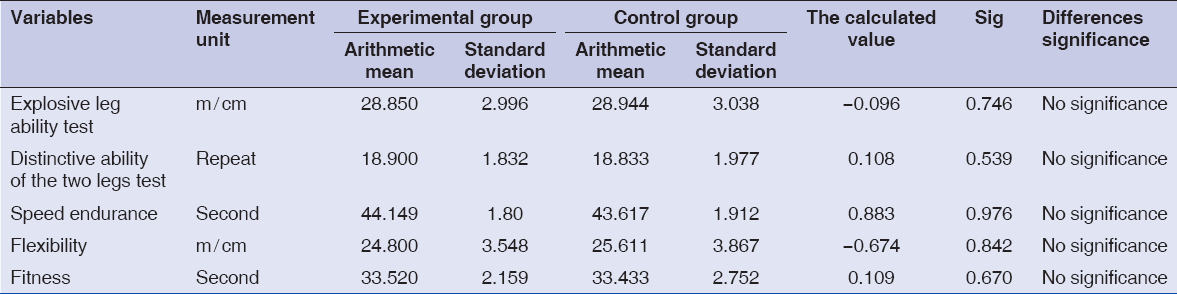
Researcher had to verify the equality of the two sets of tests search to ensure the only project line between the two groups, as shown in Table 3.
Table 3: Shows the equality of sample in the previous tests for the control and experimental groups
The researcher adopted the following tests:
First, tests for physical abilities: -
-
Vertical jump of fortitude to measure the explosive power of the two legs in the highest vertical jump (Mohammad Hassan Allawi, Mohamed Nasr Addin Radwan: 1994.84).
-
Test of bending and stretching knees in (20) seconds to measure the fast strengths of leg muscle (Qais Naji Abdul-Jabbar, Bastawisi Ahmed: 1987.344).
-
Shuttle running test (25 m × 8) higher start: -speed endurance measurement (Kamal Abdel-Hamid, Mohammed Subhi Hassanein: 1987.286).
Second, tests of kinetic abilities:
-
Trunk bend test by standing on a box with (50 cm) oh height: - measuring the flexibility of the trunk and rear thigh in the front bend of movements from a standing position (Muhammad Subhi Hassanein, Hamdi Abdel-Moneim: 1997.131 to 132)
-
Barow fitness test (Mohammed Nasr Addin Radwan: 1994.265)
Scientific weight of the tests has been verified for validity, reliability and objectivity.
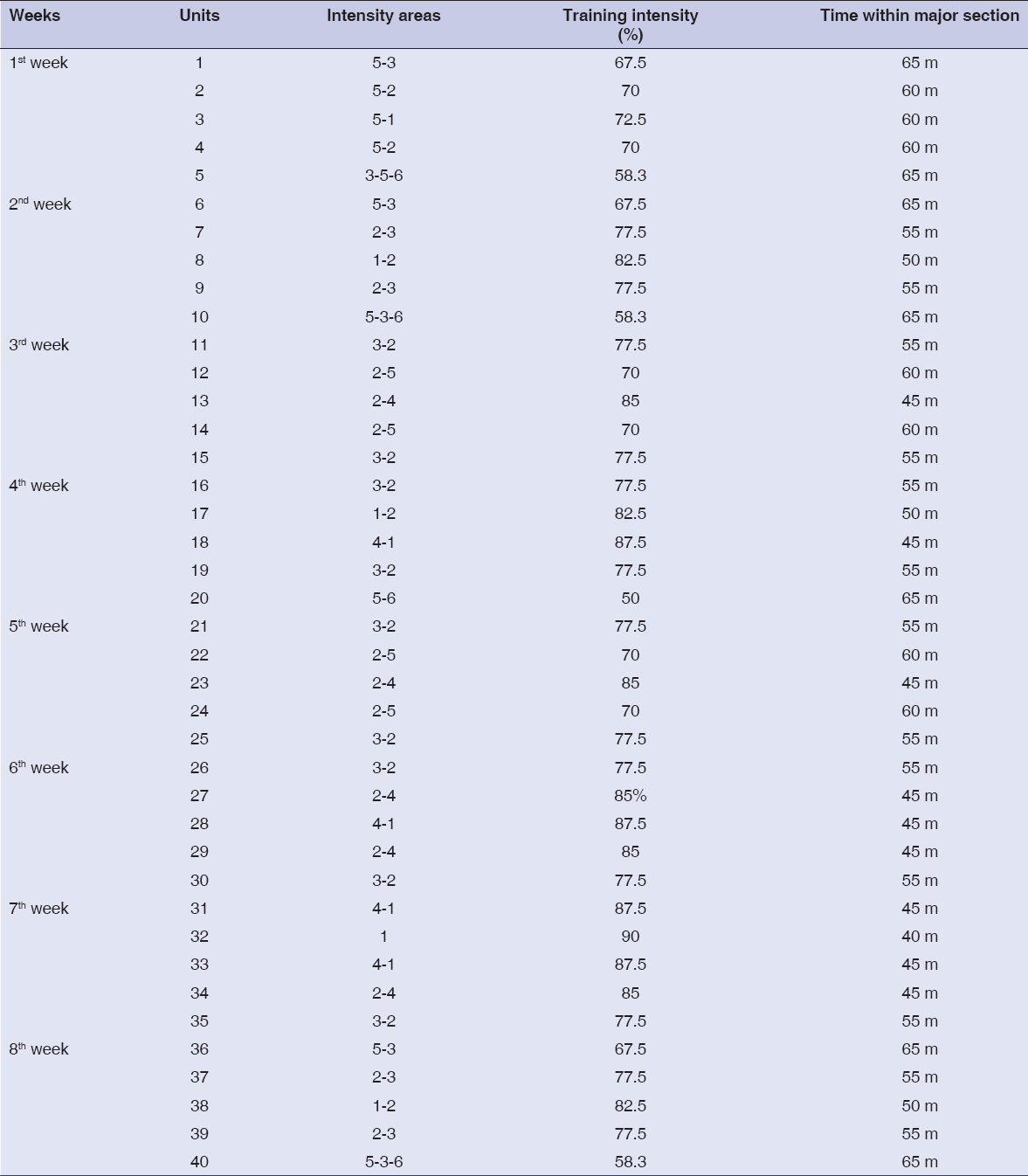
Research procedures were identified to hold previous tests and over on Sunday and Monday 21 -22/2/2016, and then the training program applied for the period from 25/02/2016 until 14/04/2016, as included five training units per week and by five days per a week for a period of 8 weeks, and in the setting stage, intensity areas were distributed in the training program in accordance with the training modules and to ensure that there is sufficient recovery stage between training area and another and between the training module and another. Interim method of training was adopted (interval) (Appendix Tables 1 and 2).
Post tests for the two experimental and control group was conducted, in almost the same conditions, as they were previous tests. Post tests were conducted on Sunday and Monday of 17-18/4/2016.
Display, Analyze and Discuss the Results
After completion of the trial proceedings, results have been statistically processed by mediated Statistical bag system, which is shown in Tables 4-6, as follows:
Table 4: Significant differences between previous and past test for control group and evolution ratios
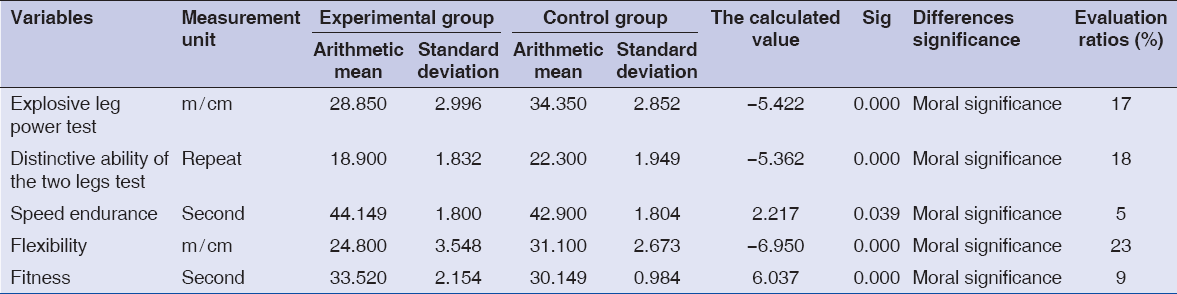
Table 5: Significant differences between previous and past test for experimental group and evolution ratios
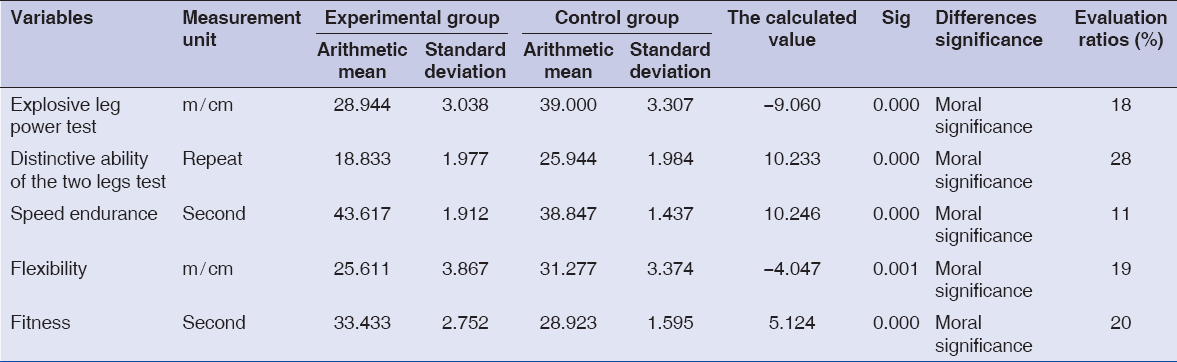
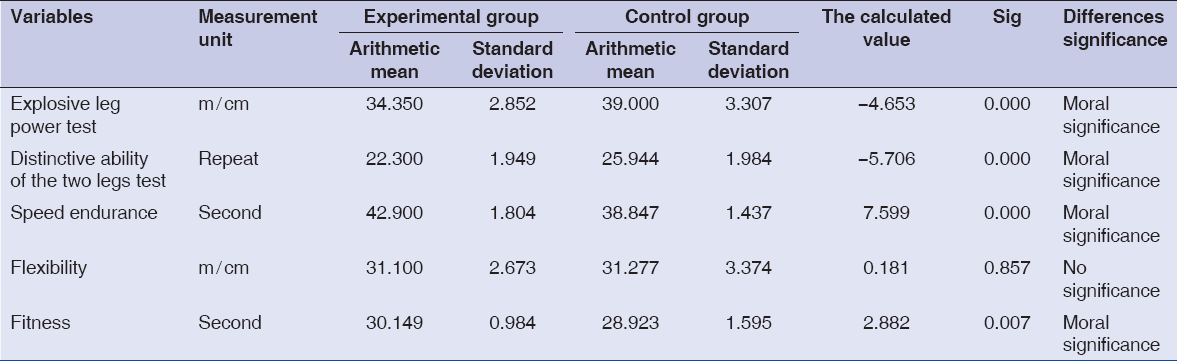
Table 6: Difference significance between the post tests for the two sets of search
It is clear from Table 4 that the results of the physical and kinetic tests were significant and in favor of later tests. This is due to the efficiency of training by the trainer and the commitment of the players accordance to power systems, whereas training for five days a week, in line with the experimental group had developed physical and kinetic abilities of the control group, we may also note that the development rates of physical and kinetic abilities ranged from 5% - 23%, which is a new development evolution confirms the safety of the followed training curriculum according to the energy Systems.
Table 5 shows that all-physical and kinetic tests had achieved a moral distinctions for dimensional test results, and development rates ranged between (11%-28%). These ratios is very excellent if compared and the duration of the training program. Reacher attributes this development in training group according to the training intensity areas to the nature and privacy of these areas and employed in training methodology, which caused a significant difference as well as advanced development ratios.
Table 6 shows that all the results of physical and skill tests have achieved significant differences for the benefit of experimental group results except flexibility scalability. The results were not statistically significant, this is due to the nature of the experimental factor (training according to the intensity areas), which has affected positively in physical and kinetic abilities taking into account the specificities of the prevailing energy system and support physical capabilities. “The legalization of the training load properly process accompanied by progress in the level of body organs and then develop the physical attributes to achieve the best athlete level (Joseph Lazim Kemash: 1999.31).” If the nature of these exercises work in the development of muscle efficiency because of the implementation of these exercises shortly. This is what contributed in the development of the explosive power of the members of the experimental group. The rapid increase in the length of the muscle just before the crunch resulting in fast and powerful muscle contraction (Muhammad Yunus Thanon: 2000.57).
Power distinguished by speed is a physical element closely related to a factor of training. That comes through focus and good training exercises of power and speed significantly in training approaches by trainers, which have the effect on the muscle groups by re-iterations on exercises for many times and that affected positively in the level of the players. (Link between muscle strength and speed muscle is one of the sports performance requirements at high levels, and that this factor is the most important characteristic of athletes, as they have a great deal of strength and speed and have the ability to link them in an integrated form of strong and rapid movement in order to achieve optimal performance) (Raad Baqer Jaber: 1995.13)
As for the development that took place in speed afford is attributed by the researcher to the nature of the numbers according to the intensity areas, that its physiological effects is the foundation on which the training programs should be taken into consideration so that the player gat the ability to increase endurance rates and short and long distances during the exercise. This requires an increase in aerobic capacity of increasing the amount of oxygen consumed during athletic performance, and confirms (Aweys Al-Jabali) the muscles supply of oxygen will be the limiting factor of performance when the player has a high ability of oxygen (Aweys Al-Jabali: 2000.421), and highlights the importance of this ability in the performance of endurance sports and improve the level of the amount of oxygen. They help to improve the league respiratory efficiency in sport work (Wilmor: 1994. 181). As well as the aerobic exercises contribute physiologically to increase the possibility of susceptibility of mitochondria (energy houses) in muscles by increasing the amount of reserves of carbohydrates in the muscle, making the muscle less dependent on blood to get glucose causing to delay limits the phenomena of fatigue.
As for there is no moral difference in the viability of flexibility between the control and experimental groups, it confirms the importance of the athletes ability, which is not set aside by the trainers in their units, and the size of the development of two groups is parallel. “kinetic flexibility is essential to master the kinetic physical performance. Without the adequate range of motion, movement becomes limited (Mufti Ibrahim Hammad: 2001.194). Researcher agree with what he referred to (Ibrahim Ahmed Salama, 2000) as (flexibility is a way to determine the extent of progress in skill performance, especially when achieving especially flexible levels becomes within targets module)
As for fitness viability, the application of the training curriculum according to the intensity areas and diversity in the exercise requirements systematically and continuously, and their adaptation to perform athletic movements according to requirements phase developed their kinetic abilities, as the (the ability to perform movements, absorb and to quickly adapt to the kinetic activity with the requirements of the changing circumstances is of great importance in the development of fitness) (Qassim Hassan Hussein, Qais Naji Abdul-Jabbar: 1984.219) “fitness is the ability to take swift action, stop and change direction quickly. (Robert, V. Hochey:1981.p210)
It is clear from Table 7 that the explosive force evolution rates were comparable between the total samples in training group of energy regulations with training group according to intensity areas. Researcher attributes importance of this ability for most sports, but there was a difference between the sporting activities as Taekwondo, futsal and handball exceeded training according to intensity areas, but in weightlifting and swimming games in training group on energy system. Researcher attributes the priorities of this ability in sports and the absence of tactical side.
Table 7: Development percentage of training group according to the proportions of the energy systems and intensity areas training group combined and according to sporting activities
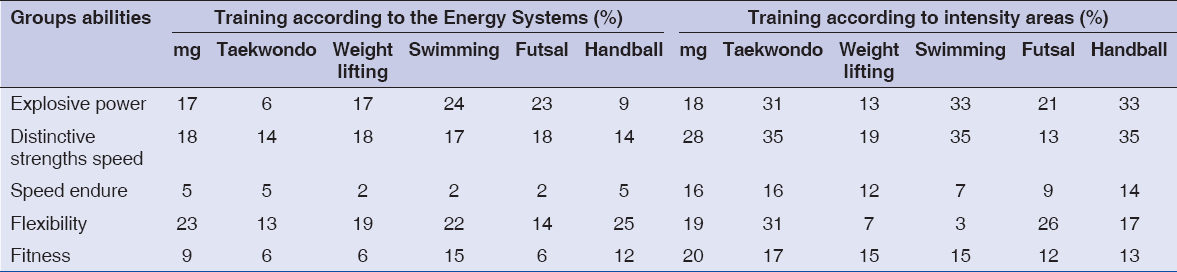
It is also clear that training group according to intensity areas contributed to develop distinctive force speed in the total sample and in taekwondo, weightlifting, football, handball Activities. Researcher attributed to the great importance attached by this style of training for this ability in more than three areas.
Training group according to the energy system has exceeded within swimming activities. Researcher attributed it to the privacy of this capability for swimming activities and the privacy of this style of training in giving adequate space.
The clear superiority of the training group according to the intensity areas in the evolution rates for speed in total and all sporting activities on the total training according to energy systems. Researcher attributes this to the adaptations occurring in functional systems, which had a great effect on speed endurance.
The training group according to the energy systems exceeded in the development of the flexibility in the total sample and the activities of weightlifting, futsal, handball ratios, as a group of intensity areas have exceeded within the activities of taekwondo and swimming. Researcher attributes this discrepancy to the individual characteristics and the nature of this ability as we noticed a marked evolution of both groups in this capacity.
It is clear that training group according to the intensity areas has exceeded in the proportions of fitness in the total sample, taekwondo, weightlifting, swimming and handball. The results between the two groups narrowed in futsal. The researcher attributes this to the adaptation happening in the body’s control adjustment because of the evolution of the physical abilities and kinetic capabilities, which reflected positively on the status of fitness, which is a recipe of kinetic capabilities.
CONCLUSIONS
-
Statistically significant differences in the results of the early and later tests in kinetic physical abilities for control and experimental groups and for later tests.
-
Statistically significant differences between the results of later tests of control and experimental groups in kinetic physical abilities for the experimental group, except for flexibility that did not show statistical difference.
-
Training group exceeded the intensity areas in the proportions of the total sample in most physical and kinetic abilities except for flexible evolution rates that were according to power systems training.
-
Proportions of evolution in physical and kinetic abilities of sports activities have varied between the two groups depending on the privacy of potential and its importance for efficiency.
-
The six intensity areas included in training methodology have contributed in developing physical abilities of research sample.
RECOMMENDATIONS
-
Adoption of the training curriculum in accordance with the intensity areas to develop of physical and kinetic abilities.
-
Using training according to intensity areas for all spots games and especially to team games.
-
Taking care of the prevailing energy system privacy when developing training programs in accordance with intensity areas.
-
The importance of training in according to intensity areas shown with sports that have skilled and planned privacy that is better activities that feature one side of physical skills.
-
It is not recommended to use training according to intensity areas with six years old groups (16) and with sport for health foe ages over 40 years.
-
It is preferable to use training according to intensity areas in special prepare and pre setup phases.
-
It is possible to make further studies to know the impact of the training according to intensity areas on functional variables and to other sports.
APPENDICES
Appendix Tables
Appenix 1: Training according to intensity areas
Appendix 2: Training program